creation date: 2026-03-30 21:08
tags: Anatomy & Physiology
Coagulation Cascade
Background
The coagulation pathway consist of a cascade of events which functions to maintain hemostasis. Specifically, it allows for rapid blockage of bleeding.
Primary hemostasis consist of the aggregation of platelets to physically plug the damaged site of exposed endothelial cells.
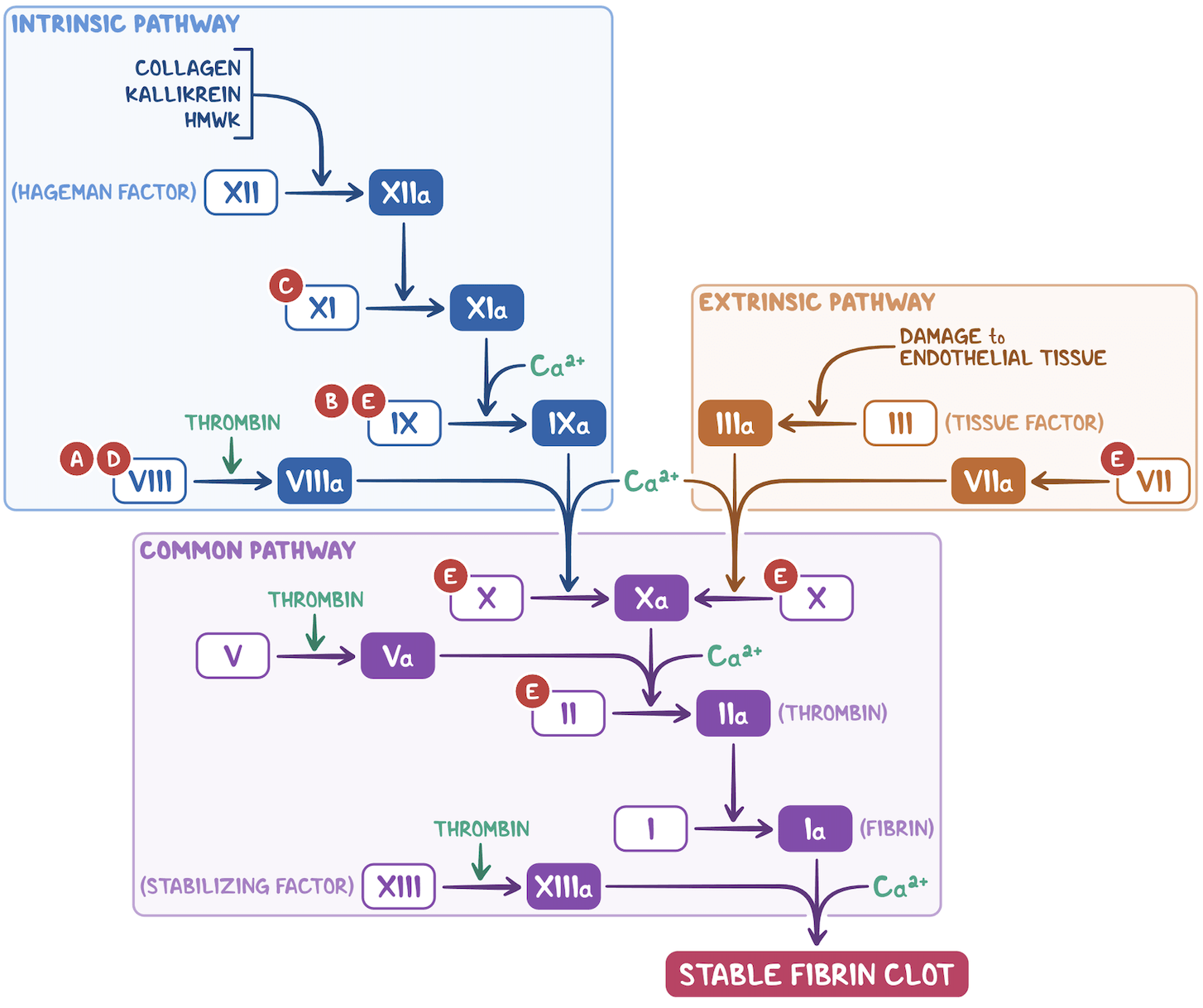
Secondary hemostasis consist of the intrinsic pathway, extrinsic pathway, and the combined common pathway that activates fibrinogen to fibrin. The fibrin bind platelets together to stabilize the plug.
Pathways
Relevant Physiology
Production of Factors
The liver produces I, II, V, VIII, IX, X, XI, XIII, and proteins C and S. Vascular endothelium produces factor VIII.
Note that factor IV is calcium ions. Factor VI does not exist (previously referred to Va).
Activation
Intrinsic Pathway
Consists of factor XII, XI, IX, and X, II, I of the common pathway
Activation begins when factor XII is exposed to endothelial collagen which occurs only when endothelial damage occurs. Activated factor XII (XIIa) catalyzes the cascade (XII, XI, IX) which catalyzes the activation of factor X.
Extrinsic Pathway
Consist of factor III, VII, and X, II, I of the common pathway.
Upon damage, endothelial cells release factor III (tissue factor) and activates factor VII to VIIa.
Common Pathway
The common pathway begins with the activation of factor X to Xa. This reaction is mediated by a complex known as tenase. Tenase can be two forms:
- Extrinsic: consisting of factor VIIa, IIIa, and Ca2+
- Intrinsic: factor VIIIa, IXa, Ca2+, and a phospholipid
Factor VIII is found circulating in the blood and is often activated by thrombin (IIa).
Activated factor X (Xa) forms a prothrombinase complex with factor Va and Ca2+. This complex activates prothrombin (II) to thrombin (IIa) which cleaves fibrinogen (I) to fibrin (Ia).
Negative Feedback
Mechanisms are in place to prevent widespread thrombosis.
Thrombin activates plasminogen to plasmin which stimulates production of antithrombin.
- Plasmin breaks down fibrin mesh
- Antithrombin decreases production of thrombin and decreases amount of Xa
Proteins C and S inactivate factor V and VIII. Protein Z is a vitamin K-dependent cofactor that inhibits Xa and XIa.
Evaluations
Laboratory values are used to gauge clotting time:
- Intrinsic pathway: partial thromboplastin time (PTT)
- Extrinsic pathway: prothrombin time (PT) and international normalized ratio (INR)