creation date: 2026-06-20 22:51
tags: Pathologies
Acetaminophen Toxicity
Background
Definitions
Acetaminophen, also referred to as Tylenol, parcetamol, or N-acetyl-p-aminophenol, is a widely used analgesic-antipyretic present as both its own formulation and as a component of a number of OTC and prescription medications.
Acetaminophen toxicity occurs when acetaminophen is taken above therapeutic levels or less in susceptible individuals and can lead to liver injury.
Pharmacology
Pharmacokinetics
Absorption
- Rapidly and completely absorbed in the duodenum
- Serum concentrations peak between 0.5-2 hrs after therapeutic dose; may be delayed by food
Distribution
- Widely distributed except in fat
- 10%-20% bound to plasma proteins
Metabolism
- Half-life of 2-4 hours via liver metabolism
- 90% metabolized to sulfate and glucuronide conjugates via sulfotransferase (SULT) and UDP-glucuronosyl transferase (UGT) for elimination
- 8% metabolized by cytochrome P450 to a toxic, highly reactive, electrophilic intermediate N-acetyle-p-benzoquinoneimine (NAPQI) which is further conjugated with hepatic glutathione to be excreted
Elimination
- Excreted through the kidney
- Remaining 2% unmetabolized is eliminated unchanged
Toxic Doses & Mechanism of Toxicity
Therapeutic recommended doses
Adults
- 325-1000 mg per dose every 4-6 hours
- Maximum of 4000 mg per day
Children
- 10-15 mg/kg per dose every 4-6 hours
- Maximum of 80 mg/kg per day
Toxicity is unlikely for single dose <150 mg/kg in a child or >7.5-10 g for an adult.
Toxic doses
Toxicity is likely for single dose >250 mg/kg or >12 g over a 24 hours. Virtually all patients who ingest dose >350 mg/kg develop severe liver toxicity without treatment.
Mechanism of toxicity
In the metabolism of acetaminophen, only a small portion is converted through cytochrome P450 enzymes to NAPQI, a toxic intermediate, before being conjugated into a nontoxic form for excretion.
At toxic doses of acetaminophen, the sulfonation and glucuronidation pathways for normal metabolism become saturated, causing more acetaminophen to be processed through cytochrome P450, resulting in greater production of NAPQI.
When hepatic glutathione stores are depleted (to roughly 20-30% remaining), NPQI accumulates and begins to react with cellular proteins. This leads to:
- Oxidative hepatocyte injury
- Alteration of mitochondrial ATP-synthase
- Hepatocellular centrilobular necrosis
The downstream effect of this is severe hepatotoxicity and liver failure.
Risk Factors
Several scenarios can increase an individual’s susceptibility to hepatotoxicity caused by acetaminophen.
- Excessive intake of acetaminophen
- Delayed treatment
- Excessive cytochrome P450 activity (eg. CYP inducers, genetics)
- Decreased capacity for glucuronidation or sulfation (eg. TMP-SMX competes for these pathways, malnutrition may reduce carbohydrate reserves needed for gluuronidation)
- Depletion of glutathione stores (eg. malnutrition, age)
The association with alcohol use and risk of hepatotoxicity is contentious. For acute alcohol use, there may be a protective element by competing with acetaminophen for CYP2E1 enzyme activity. Chronic alcohol use may upregulate synthesis and activity of CYP2E1 but appears to only be associated with overdose due to repeated supratherapeutic ingestions rather than acute overdose.
Clinical Presentation
Signs & Symptoms
Stage I: 0-24 hours following ingestion
- Nausea, vomiting, diaphoresis (sweating a lot), pallor, lethargy, malaise
- Sometimes asymptomatic
- CNS depression and elevated anion gap metabolic acidosis if:
- High-risk overdose (>30 g)
- Co-ingestants such as diphenhydramine, opioids, aspirin
- Serum aminotransferase levels (ALT, AST) often normal but can rise as early as 8-12 hours post-ingestion if severe
Stage II: 24-72 hours
- Initially, stage I symptoms resolve, appearing to improve clinically
- Subclinical elevation of AST, ALT; elevated PTT and bilirubin
- Progresses to RUQ pain, hepatomegaly, and liver tenderness
- Oliguria and kidney dysfunction
Stage III: 72-96 hours
- Reappearance of systemic symptoms with jaundice, confusion (hepatic encephalopathy), elevation of hepatic enzymes, hyperammonemia, bleeding
- Severe hepatotoxicity:
- ALT, AST >10000 IU/L
- Prolonged PT/INR
- Hypoglycemia
- Lactic acidosis
- Total bilirubin concentration above 68 mcmol/L
- Acute kidney injury in 10-25% of those with significant hepatotoxicity
Stage IV: 4-14 days
- Recovery phase if survived stage III
- Histologic changes in liver ranges from cytolysis to centrilobular necrosis (centribulobular region associated with site of maximal production of NAPQI due to concentration of CYP2E1)
History & Physical Exam
History follows that of a toxic exposure:
- Substance identification
- Exact name and formulation
- Concentration of toxin
- Time of exposure
- Acute vs. chronic ingestion
- Quantity and formulation
- Number of pills, volume, or estimated amount
- Immediate vs. extended release
- Intent and co-ingestants
- Accidental vs. intentional ingestion
- Identify any co-ingestants (eg. alcohol)
Diagnosis
Criteria
Work-up
Laboratory orders
In patients with established toxicity or predicted to develop toxicity based on history, initial testing includes:
- Serum acetaminophen concentration
- Electrolytes
- BUN and creatinine
- Total bilirubin
- PT and INR
- Liver chemistries
- Amylase
- Urinalysis
- Co-ingestants
In patients with altered mental status, include:
- Blood gases
- Serum lactate
In patients with intentional ingestions or unreliable histories:
- Toxic screen of blood and urine
Assessment of hepatotoxic risk
For acute ingestion, the Revised Rumack-Matthew nomogram can be used to gauge risk of hepatotoxicity:
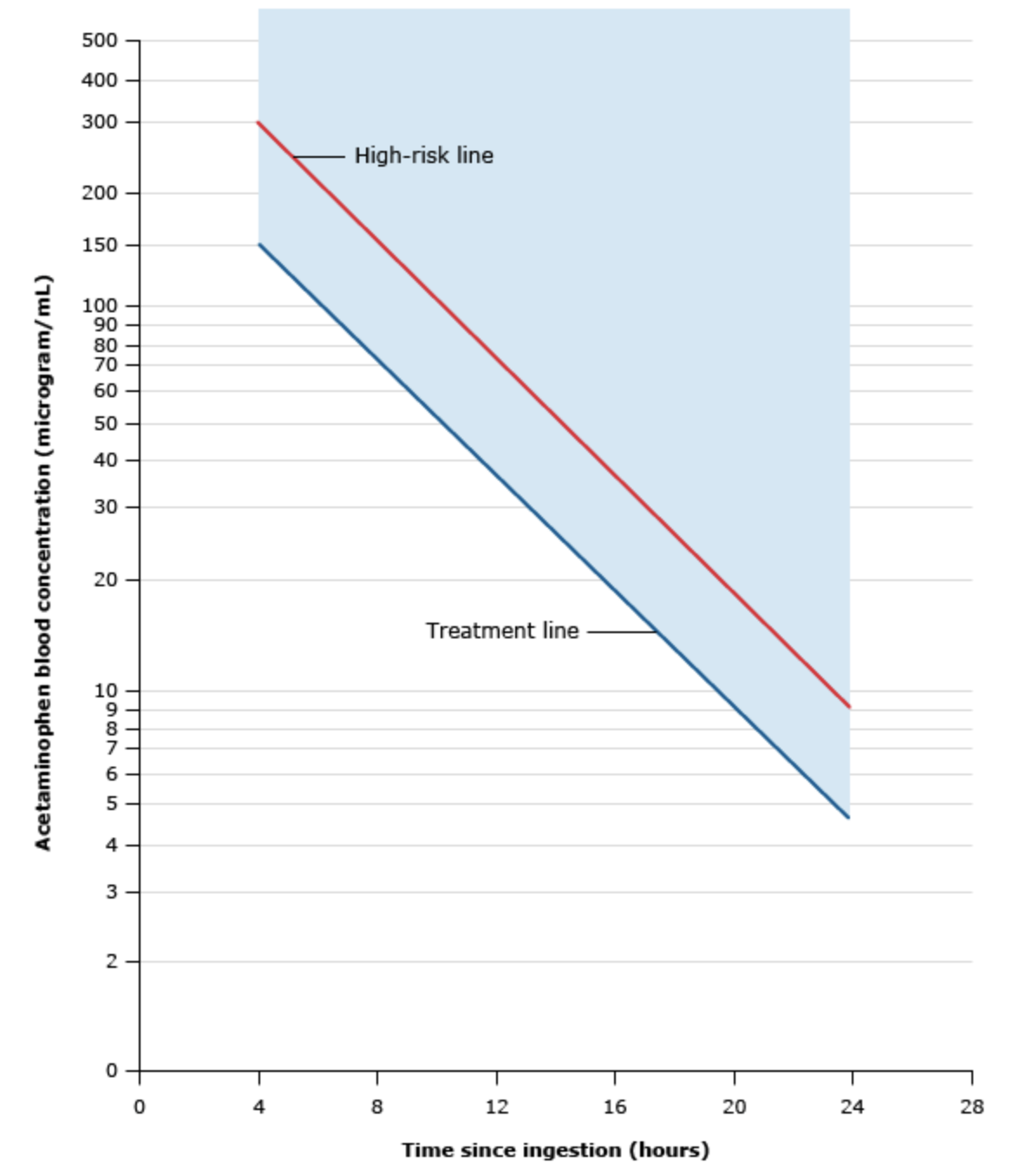
The serum concentration of acetaminophen can be used to guide further treatment. It requires the measurement to be made after 4 hours from ingestion.
For acute ingestion of extended-release formulation or co-ingested with anticholinergic or opioid:
- If above treatment line, initiate treatment without repeat serum acetaminophen measurement
- If below the treatment line at hour 4-12 but >10 mcg/mL, repeat measurement in 4-6 hour
- For co-ingestants, if below treatment line between hour 4-24, same repeat
For repeat supratherapeutic ingestion, the nomogram is not used, instead increased risk is attributed to:
- If ingestion period was 24-48 hours of >6 g/day
- If ingestion period >48 hours of >4 g/day
- Abdominal pain or RUQ tenderness, nausea, vomiting, jaundice, ill-appearing, or mental status changes are present
Differential
Unlike other forms of hepatitis, acetaminophen-induced hepatitis is acute, rapidly progressing, and characterized by marked elevation of liver enzymes. As such, other hepatitises can be ruled out clinically.
Other diagnoses for acute hepatic dysfunction include:
- Alcohol- or other drug-related hepatitis
- Viral hepatitis
- Hepatobiliary disease
- Reye syndrome
- Ischemic hepatitis
Red Flags / Complications
Acetaminophen toxicity is a major cause of acute liver failure, which once developed, results in a 28% mortality and 33% risk of liver transplantation.
Management
Gastrointestinal Decontamination
Gastrointestinal decomtaination with a single dose of activated charcoal (1 g/kg, max 50 g) is indicated if:
- Presentation within 4 hours of a known or suspected toxic ingestion
- High-risk ingestions (>30 g), especially if there are evidence of ongoing absorption such has increasing concentration
It should be noted that for a non-high-risk ingestion, AC has limited value beyond 4 hours as absorption will have completed.
Antidotal Acetylcysteine
Acetylcysteine is indicated in cases of:
- Risk of hepatotoxicity as determined by the above assessment
- Patients with unreliable history and acetaminophen >10 mcg/mL or elevated aminotransferases
- Patients with signs and symptoms of liver injury with history of acetaminophen ingestion, regardless of acetaminophen concentration
A number of regimens exist. Regardless of route and rate, it should deliver 300 mg/kg acetylcysteine PO or IV during first 20-24 hours of treatment.
- Two bag 20 hour IV regimen:
- 4-hour infusion at 50 mg/kg/hr (200 mg/kg over 4h)
- Then, 15-hour infusion at 6.25 mg/kg/hr (100 mg/lg over 16h)
- Continue infusion at 6.25 mg/kg/hr if stopping criteria not met
- Oral regimen
- Loading dose of 140 mg/kg PO
- Then, 70 mg/kg PO q4h until stopping criteria are met
Clinical endpoints are used to determine when to stop treatment. After initial treatment is completed (eg. 300 mg/kg over 20-24h), acetylcysteine can be discontinued if all of the following are met:
- Serum acetaminophen concentration <10 mcg/mL
- INR <2.0
- ALT and AST are normal/at baseline, or decreased 25-50% from peak
- Patient is clinically well
For patients with unreliable history (2nd indication above), acetylecysteine is administered for 12 hours and serum acetaminophen is repeated.
Additional Treatments
For patients with high-risk ingestion, additional supportive measures may be needed:
- Airway management for altered mental status
- IV fluids and/or vasopressors for shock
- Bicarbonate for severe metabolic acidosis
In patients with a serum acetaminophen ≥ 900 mcg/mL, and altered mental status or metabolic acidosis, hemodialysis is recommended in addition to acetylcysteine. Nephrology should be consulted.
In patients with fulminant liver failure, hemodialysis and liver transplantation may be necessary.
Disposition
Resumption of acetaminophen use
Following overdose, patients may resume use if:
- No clinical symptoms
- Serum acetaminophen concentration <10 mg/L
- Normal ALT, PT, and INR
Prevention of recurrence
Patients should be counselled on safe acetaminophen use. This includes:
- Adhering to weight base dosing and daily maximums
- Avoiding concurrent acetaminophen use with acetaminophen-containing medications (eg. acetaminophen-opioid combinations)
- Child poisoning best practices