creation date: 2026-10-09 12:55
tags: Interventions
Prenatal Schedule
Background
Prenatal schedule, or antenatal schedule, refers to the timing of testing, immunizations, and other components of care prior to delivery.
Schedule
0-13 Weeks
At the first appointment (usually presenting after amenorrhea / positive pregnancy test).
Bloodwork
- CBC (Hb, Hct)
- ABO and Rh
- Rubella
- Hepatitis B
- Hepatitis C
- STI
- HIV
Urine
- Confirms pregnancy with bHCG (present 8 days after conception)
Dating ultrasound
- Identification of gestational age via crown-rump length
- Before 14 wks gestation, precision of 5-7 days
- Variability in estimates increase with with increasing duration of pregnancy
- Use early scan for gestational age, and not redate in later trimesters
- If crown-rump length >84mm (14 weeks gestation), may need to combine other methods such as:
- Biparietal diameter (outer edge of proximal skull to inner edge of distal skull)
- Head circumference
- Abdominal circumerfence/aver abdominal diameter
- Femoral diaphysis length (most accurate single method for gestation age in 3rd trimester)
- Ultrasound-established dates replace menstrual dates when:
-
5 days before 9 weeks
-
7 days between 9-15 weeks
-
10 days between 16-21 weeks
-
14 days between 22-27 weeks
-
- Ultrasound confirms menstrual dates if agreement is:
- <7 days obtained by crown-rump length in first trimester
- <14 days obtained by average of multiple methods between 14-27 weeks
eFTS
- Screens for genetic conditions (Trisomy 21 and 18
- Nuchal translucency
- Protein measurement in blood
14-27 Weeks
Anatomy scan ultrasound (18-22 weeks)
- EDC: estimated date of confinement (ie. due date)
- EGA: estimated gestational age
- Visibility of fetus
- Amniotic fluid volume
- Location of placenta (relative to internal os)
- Low-lying: 1-20 mm to internal os
- Appearance of fetus
- Vessels
- Normal = 3 (2 arteries, 1 vein)
- 4 may signify GI or CV anomalies
- Cord insertion
- Transverse section view of abdomen for clean insertion of cord into abdominal wall
- No evidence of associated mass (gastrochisis/comphalocele)
Glucose challenge test (24-28 weeks)
- Approach (alternatives discussed separately):
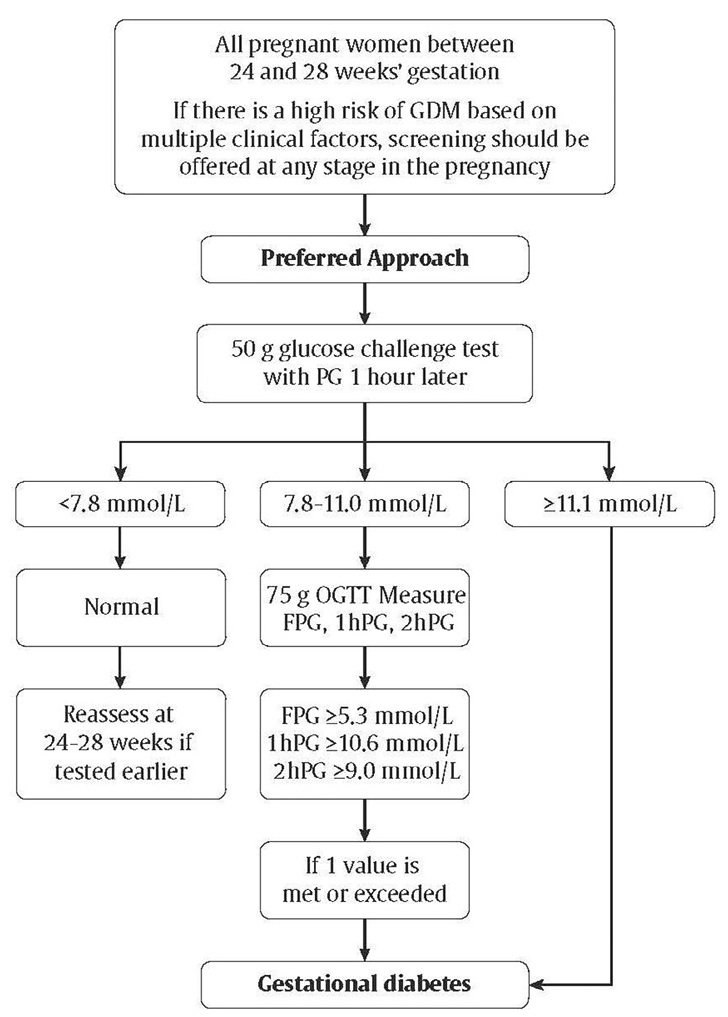
Bloodwork (24-28 weeks)
- CBC for anemia
Tdap vaccination (28-32 weeks)
- Often done with flu/COVID
28-40 Weeks
Routine appointments
- Every 2 weeks, then weekly as due date approaches
- Monitoring for diabetes, blood pressure, position of fetus
Antibody screening (28 weeks)
- If Rh negative, RhD immune globulin given
Growth ultrasound (32, 36 week)
- Indicated for size concerns or complications
GBS swab (35-37 weeks)
If positive, IV antibiotics start 4 hours prior to delivery:
- First-line: penicillin G or ampicillin
- Low risk penicillin allergy: cefazolin
- High risk penicillin allergy: clindamycin (if susceptible) or vancomycin
Note: prophylaxis is not necessary if planned c-section before labour onset with intact amniotic membranes.