creation date: 2026-09-10 12:20
tags: Interventions
Code Blue Protocol
Background
Code Blue is the hospital designation for cardiac or respiratory arrest response. This is based on the AHA Adult Basic and Advanced Cardiovascular Life Support (ACLS) algorithm.
Procedure
Identification and Activation
Recognize a code by:
- Attempt to rouse unconscious patient verbally
- Attempt to rouse patient physically (trapezius pinch, periorbital pressure)
- Check pulse and watch for chest rise
If a patient is pulseless with absent or abnormal (agonal/gasping) breathing, call the code.
- Bring crash cart, defibrillator
- Roles should be assigned:
- Team lead
- Compression
- Airway/ventilation
- Monitor/defibrillator
- Vascular access/medications
- Recorder/documenter
CPR
- Rate: 100–120 compressions/min.
- Depth: at least 5 cm (2 in) and no more than 6 cm; excessive depth (>6 cm) is associated with reduced survival.
- Recoil/interruptions: allow full chest recoil, avoid leaning, minimize interruptions, and rotate compressors every 2 minutes; target chest compression fraction ≥60–80%.
- Compression:ventilation ratio: 30:2 before an advanced airway; once an advanced airway is in place, continuous compressions with 1 breath every 6 seconds (10 breaths/min).
- Monitoring: use waveform capnography for CPR quality and ROSC detection; an abrupt ETCO2 rise suggests ROSC.
Rhythm-Based Algorithm
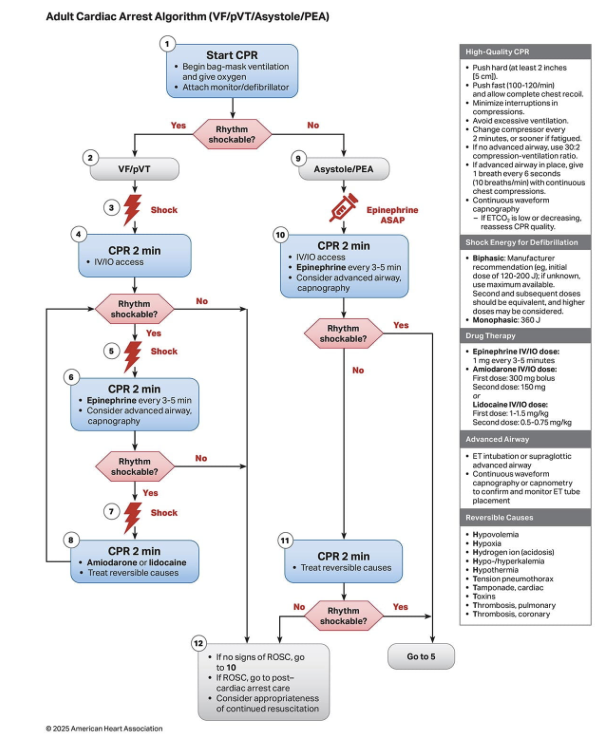
Post-Resuscitation
Following resuscitation:
- Maintain SpO2 >94% via advanced airway and ventilation
- 12-lead ECG
- Crystalloid fluids to restore volume
- Intra-arterial BP monitoring
- Determine etiology (cardiac: consider cath lab, non-cardiac: consider CT brain/CTPA)
Patients will need to be admitted to ICU for further management.