creation date: 2026-08-01 14:38
tags: Anatomy & Physiology
Heart
Background
Anatomy and Physiology
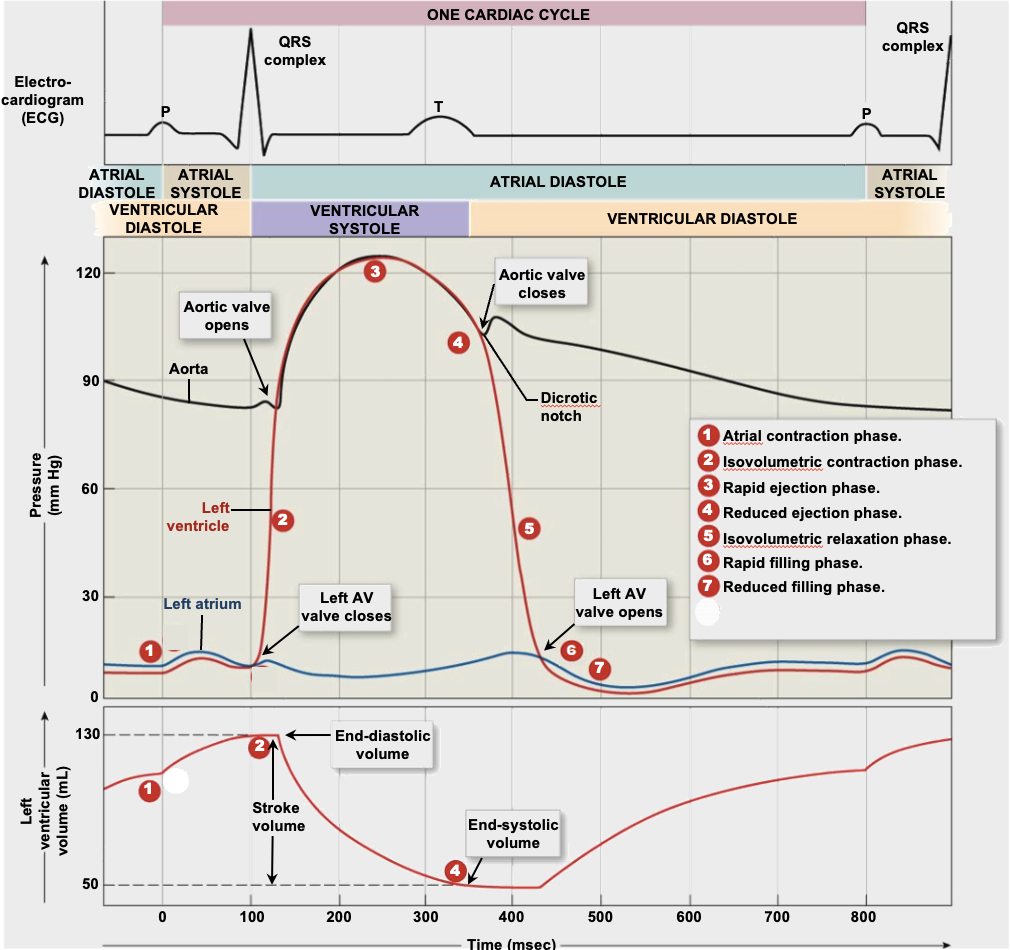
Cardiac Cycle
Valves
Foramen Ovale
Opening through the interatrial septum that connects the atria before birth. This closes off at birth to form the fossa ovalis.
If it fails to close, this is known as atrial septal defect (ASD).
Coronary system
Anatomy
Coronary arteries
- Right coronary artery (RCA)
- Supplies the right atrium and right ventricle
- Sinoatrial nodal artery supplies SA node
- Supplies AV node via septal perforating branch (90% of people)
- Descends into smaller branches:
- Right posterior descending artery (PDA)
- Posterior 1/3 of interventricular septum
- Acute marginal artery
- Right posterior descending artery (PDA)
- Left main coronary artery (LMCA)
- Left anterior descending (LAD) artery
- Anterior portion of left ventricle
- Left circumflex (LCx)
- Left atrium and posterior-lateral aspect of left ventricle
- Smaller branches
- Obtuse marginal artery
- Diagnoals
- Septal perforator
- Left anterior descending (LAD) artery
- Coronary anastomoses
- Between the circumflex and RCA
- Between the anterior and posterior interventricular arteries
- Stabilizes blood supply
Coronary veins
- Anterior cardiac vein
- Empties to right atrium
- Great cardiac vein
- Empties to coronary sinus
- Drains posterior , middle, and small cardiac veins
- Coronary sinus empties into right atrium
Coronary perfusion pressure
- Pressure that drives blood flow through the coronary arteries to the heart’s muscle
- Calculated with left ventricular end-diastolic pressure (LVEDP) and aortic diastolic pressure (ADP)
- CPP = ADP - LVEDP
- During contraction (systole), arterial branches are compressed and thus perfusion occurs during diastole
- Coronary blood flow moves from epicardial (where pressure is approx. ADP) to endocardial (which would be LVEDP at the left ventricle)
- Pressures needed are lower in the right ventricle and thus perfusion occurs in systole as well as systolic aortic pressure > systolic RV pressure.
- Normal range: 60-80 mmHg
End diastolic pressure
- Refers to the pressure in the heart’s ventricle at the end of diastole
- Elevated EDP may indicate non-compliant/stiff ventricle